
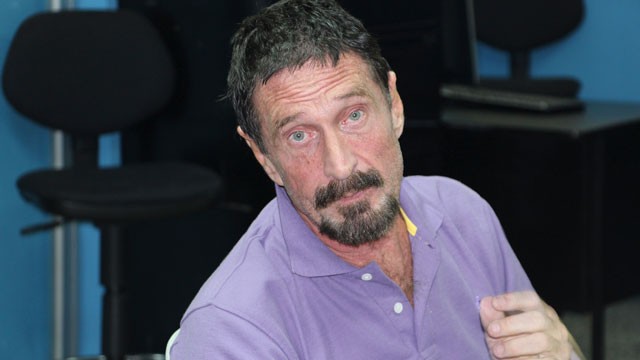
Software millionaire John McAfee has been returned to an immigration detention cell in Guatemala after being rushed to a Guatemala City hospital via ambulance.
McAfee, 67 -- who soon may be deported back to Belize, where authorities want to question him about the shooting death of his neighbor -- was reportedly found prostrate on the floor of his cell and unresponsive.
He was wheeled into the hospital on a gurney. Photographers followed in pursuit right into the emergency room, but as emergency workers eased McAfee's limp body from the gurney and onto a bed and began to remove his suit, he suddenly spoke up, saying, "Please, not in front of the press."
Earlier today, McAfee had complained of chest pains, raising concerns he might be having a heart attack.
However, that did not appear to be the case. Hours after his emergency, hospital officials sent McAfee back to the detention center, telling ABC News they found no reason to keep him overnight.
In a phone interview overnight, McAfee told ABC News, "I simply passed out, everything went black."
He said he hit his head on the floor when he collapsed. McAfee explained that for the past 48 hours he hasn't eaten and had very little to drink.
McAfee had been scheduled to be deported to Belize, ABC News has learned. But a judge could stay the ruling if it is determined that McAfee's life is threatened by being in Belizean custody, as McAfee has claimed in the past several weeks.
McAfee's attorneys hope to continue delaying the deportation by appealing to the Guatemala's high court on humanitarian grounds.
Raphael Martinez, a spokesman for the Belize government, said that if McAfee is deported to Belize, he would immediately be handed over to police and detained for up to 48 hours unless charges are brought against him.
"There is more that we know about the investigation, but that remains part of the police work," he said, hinting at possible charges.
He added that a handover by Guatemala would be "the neighborly thing to do."
A spokesman for the U.S. embassy in Guatemala said that "due to privacy considerations," the embassy would "have no comment on the specifics of this situation," but that, "U.S. citizens are subject to the laws of the countries in which they are traveling or residing, and must work within the host countries' legal framework."
Post a Comment